Luxury Forest Retreats USA: A 2026 Strategic Editorial Guide
The American forest has historically been a site of extraction, folklore, and rugged survival. Yet, in 2026, the domestic landscape has seen the emergence of a sophisticated architectural and operational genre: the pressurized, climate-resilient, deep-timber sanctuary. This evolution represents a fundamental shift in the traveler’s hierarchy of needs. We are moving away from the gilded, high-traffic corridors of urban luxury hotels toward “managed wildness,” the ability to inhabit the profound silence of old-growth forests without sacrificing the biological or psychological comforts of a flagship metropolitan suite.
The rise of this sector is driven by a phenomenon we might call “Acoustical and Circadian Exclusivity.” As urban environments become increasingly saturated with anthropogenic noise and blue-light pollution, the deep forests of the Pacific Northwest, the Blue Ridge Mountains, and the Northwoods offer the only remaining “Quiet Zones” in the lower 48 states. However, the technical challenge of maintaining a five-star standard in an environment characterized by high humidity, organic decay, and volatile weather patterns is immense. The properties that define the peak of the market are those that have solved the “Entropy Puzzle,” maintaining structural and operational elegance against the relentless pressure of a living, breathing forest.
To identify the definitive leaders in this space, one must look beyond the visual allure of a timber-framed lodge or a glass-walled cabin. True authority in forest-centric hospitality is built on “Operational Invisibility.” This is the ability of the resort to provide a seamless, high-end experience where the guest never perceives the heavy hand of management required to maintain off-grid power, moisture control, and wildlife boundaries. This report deconstructs the mechanics of elite silvicultural stays, providing a rigorous framework for evaluating the assets that define the contemporary standard for American forest luxury.
Luxury forest retreats USA

Navigating the fragmented marketplace of domestic woodland stays requires a move away from aesthetic-first rankings and toward a “Logistical Integrity” audit. When evaluating luxury forest retreats USA, the primary differentiator is the “Thermal-Comfort-to-Humidity Ratio.” A forest is an environment of constant organic respiration; a property that looks beautiful at sunset but feels damp at 2 AM or smells of stagnant moisture is a failure of luxury. The premier sites distinguish themselves by integrating active dehumidification, radiant floor heating, and advanced HEPA filtration into “permeable” structures like glass cabins or modernized A-frames.
A frequent misunderstanding in this sector is that remoteness is synonymous with quality. While these retreats often require significant transit, the true value lies in “Curated Isolation.” A site located five miles from a major logging road may suffer from persistent industrial noise, even if the visual landscape is stunning. Conversely, a site situated forty miles into the interior of a private timberland offers a level of acoustical purity that justifies its premium. Sophisticated travelers prioritize properties that possess “Proprietary Topography” natural features like ravines or dense canopy breaks that provide a physical barrier to the outside world.
Oversimplification also risks ignoring the “Invisible Infrastructure” of the stay. In a forest environment, the management of moisture and insects is the ultimate luxury. For a site to be considered elite, it must demonstrate “Biotic Grace,” the ability to provide a bug-free, temperature-stable environment without the use of harsh chemical barriers or unsightly, loud mechanical systems. The current leaders in the field utilize passive design, such as strategic orientation for wind-driven ventilation and thermal-mass flooring, ensuring that the guest’s comfort does not come at the expense of the forest’s delicate olfactory profile.
The Historical Transition: From Frontier Hardship to Arboreal Luxury
The trajectory of the American forest stay is a narrative of “Atmospheric Control.” In the early 20th century, the forest was primarily a destination for those seeking the “Fresh-Air Cure” for respiratory ailments. Lodging was utilitarian, focusing on maximum ventilation and simple wood-stove heating. By the mid-century, the “National Park Lodge” era introduced a domesticated version of the forest, but it was often disconnected from the landscape, relying on heavy timber walls to shut nature out.
We are now in the “Integrated Immersion” phase. Modern forest luxury is a response to the “over-domestication” of travel. Guests want the sensory input of the woods, the smell of rain on hemlock, the sound of wind through the canopy, without the physical degradation of traditional camping. This has led to a structural evolution from the simple log cabin to high-tech mirror-glass cabins and elevated treehouses. In 2026, the definition of a “best” site is no longer just about the bedding; it is about the “Architectural Dialogue” between the shelter and the soil, how the structure breathes, reflects, and protects.
Conceptual Frameworks: Mental Models of Forest Resilience
To achieve professional-grade evaluation of a forest property, utilize these three mental models:
-
The “Vapor-Pressure” Stress Test: Assessing a structure’s ability to maintain a 45% internal humidity level while the exterior environment is at 95% humidity. If the site relies solely on portable dehumidifiers, it is vulnerable; if it uses integrated HVAC and vapor-barrier engineering, it is resilient.
-
The “Acoustic-Shadow” Coefficient: Evaluating the site’s “Sound Integrity.” In the forest, sound is absorbed by the canopy but can carry along watercourses. The best sites use “Topographical Shielding,” placing units in depressions or behind ridges, to ensure total silence regardless of wind direction.
-
The “Biophilic-Integration” Framework: Measuring the structure’s visual impact on the local flora. A luxury resort that clears ten acres for a “view” is less sophisticated than one that utilizes “selective pruning” and elevated piers to nestle the structure into the existing canopy without disturbing the root systems.
Key Categories of Forest Structures and Regional Trade-offs
The choice of structure in the forest is a tactical response to the specific sub-climate of the region.
| Category | Typical Region | Structural Strength | Tactical Trade-off |
| Mirror Cabins | Pacific NW / Cascades | Total camouflage; Insulation | Bird-strike risk; High exterior cleaning |
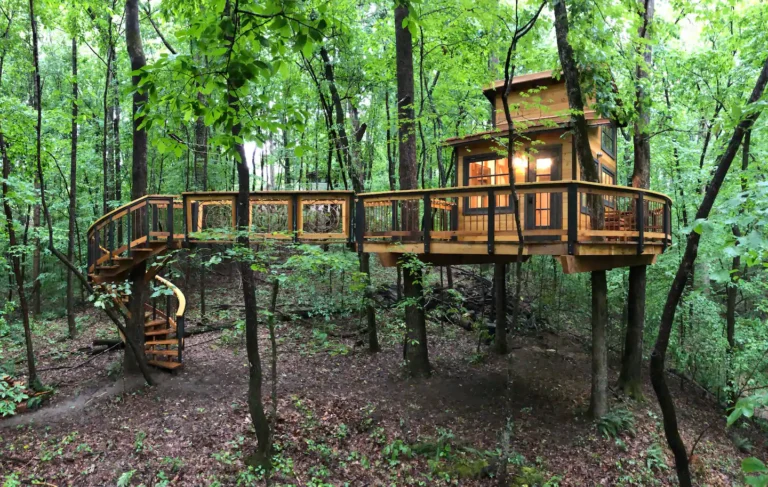
| Elevated Treehouses | Blue Ridge / Appalachia | Canopy access; Natural airflow | High vibration in wind; Labor-intensive service |
| A-Frame Pods | Northwoods / Maine | Snow-shedding; Iconic design | Limited upper-floor square footage |
| Glass Enclosures | Adirondacks / Vermont | Maximum visual immersion | High heat gain in summer; Zero privacy |
| Modernist Adobes | High Forest / New Mexico | Thermal mass; Fire resistance | Can feel “closed-in”; Minimal forest-scent flow |
Realistic Decision Logic
When choosing a structure, the traveler must decide between “Visual Immersion” and “Tactile Stability.” Glass cabins offer the highest level of connection to the woods but require the guest to be more tolerant of sunlight and temperature shifts. For those who prioritize “Residential Sleep Quality,” hard-sided structures like mirror cabins or elevated pods are superior, as they provide the acoustical and thermal insulation required for deep rest.
Detailed Real-World Scenarios and Operational Decision Points
The “Humidity-Spike” Resilience Test
-
Context: A luxury glass cabin in the Olympic Peninsula during a week of persistent “Atmospheric River” rain.
-
The Event: Exterior humidity remains at 99% for five consecutive days.
-
Failure Mode: Condensation on the interior glass obscures the view; towels never dry; wood finishes begin to swell.
-
The “Best Site” Response: Properties utilize “Positive Pressure” ventilation and heated window-mullions to ensure the glass remains clear and the interior remains dry, regardless of exterior saturation.
The “Wildlife-Encounter” Logic
-
Context: A high-end retreat located in “Grizzly Corridor” or “Black Bear” territory.
-
The Risk: Guests leave food on a deck, attracting apex predators to the guest units.
-
The Failure: The resort uses standard “Bear-Proof” bins but has no physical perimeter strategy, leading to a guest-wildlife conflict.
-
The “Best Site” Response: Elite operators utilize “Invisible Fencing” or elevated boardwalks that prevent large mammals from approaching the structures while maintaining a seamless visual landscape for the guest.
Planning, Cost, and Resource Dynamics
The economics of forest luxury are driven by the “Cost of Maintenance.” Everything, including water, electricity, and linen service, must be managed in a high-friction environment where moisture and organic growth are constant.
| Cost Tier | Nightly Range | Primary Asset | Opportunity Cost |
| Ultra-Luxe | $1,200 – $3,500 | Private Butler; Remote Old-Growth | Long lead times (12-18 mo booking) |
| Premium | $600 – $1,100 | En-suite Spa; Climate Control | Proximity to other guest units |
| Boutique | $300 – $550 | Aesthetic Design; Off-grid | No on-site staff; Shared bathhouse |
The “Maintenance Premium”: A site that is a “bargain” in the spring may be an olfactory disaster by the fall due to poor moisture management. A $1,500 stay in October in the Blue Ridge offers “peak” value because the weather allows for active humidity control without the constant use of loud HVAC units.
Tools, Strategies, and Support Systems
-
Industrial-Grade Dehumidification: The primary tool for forest luxury. Elite units use hidden, ducted systems that maintain 45% humidity without audible fan noise.
-
Starlink-enabled Fiber Mesh: In “Dead Zones” where canopy density blocks cell signal, the resort should provide localized fiber-to-the-cabin for seamless high-speed connectivity.
-
HEPA/Charcoal Filtration: To manage the “Forest Scent”—which can become overwhelming if too damp—sophisticated systems filter the air to ensure it smells crisp, not musty.
-
UVA-Reflective Glass: For mirror or glass cabins, using “Bird-Safe” coatings that are visible to avian life but invisible to humans, preventing the ecological failure of bird strikes.
-
Elevated Helical Piers: A foundation strategy that prevents root-compaction, allowing the forest to grow under the structure without compromising its stability.
-
Off-Grid Energy Autonomy: Utilizing solar-plus-storage and bio-propane generators to maintain five-star services regardless of local power outages.
The Risk Landscape: A Taxonomy of Silvicultural Failure Modes
-
The “Moisture-Bridge” Failure: A structure with metal frames that aren’t thermally broken, leading to “indoor rain” (condensation) during cold forest nights.
-
The “Canopy-Drop” Risk: Failure to manage “danger trees” (dead limbs) above guest units, leading to structural damage during high wind events.
-
The “Olfactory Overload”: A site with poor drainage where the smell of decomposing leaves and wet soil becomes trapped under the structure and infiltrates the unit.
-
The “Acoustic-Corridor” Leak: A site that looks remote but is located in a “Sound Tunnel” where forest wind amplifies the noise of a nearby highway or railway.
Governance, Maintenance, and Long-Term Adaptation
Operating in the forest is a constant battle against “Organic Encroachment.”
-
The “Moisture-Audit”: High-end sites must perform quarterly inspections of all seals, vapor barriers, and HVAC drains. In the woods, a small leak becomes mold in weeks.
-
Canopy Management: Ethical sites perform “Selective Arboriculture,” removing deadwood to protect guests while ensuring the canopy remains dense for privacy and shade.
-
The “Sand-Blast” Review: Checking the exterior finishes (especially glass) after every wind event exceeding 30 mph to ensure no abrasive damage from flying debris.
Measurement, Tracking, and Evaluation Signals
-
Leading Indicator: The “Relative-Humidity Delta,” the difference between interior and exterior saturation. A healthy unit maintains a 50% delta during rain events.
-
Lagging Indicator: The “Organic Growth Rate” on the structure’s exterior. High-end sites use anti-microbial coatings to prevent moss and algae from taking hold of the siding.
-
Qualitative Signal: The “Duration of Deep Sleep.” Elite sites track guest feedback on sleep quality, as this is the primary indicator of successful thermal and acoustical management.
Common Misconceptions and Market Oversimplifications
-
“The forest is always quiet”: This is a myth. Forests are incredibly loud (wind, birds, water). “Luxury” is the ability to filter these sounds so they are soothing, not disruptive.
-
“Glass cabins have no privacy”: Not always. Flat-top mirror glass often provides a one-way visual barrier that allows guests to see out while being invisible to those outside.
-
“Treehouses are for kids”: Modern luxury treehouses are high-end engineering feats with full kitchens, king beds, and spa baths, designed for adult seclusion.
-
“Off-grid means ‘no power'”: A few cloudy days can drop solar output, but elite sites have redundant systems to ensure guests never lose AC or hot water.
-
“You don’t need bug spray”: Even with the best architecture, insects are part of the forest. Elite sites provide high-end, organic repellents that don’t smell like chemicals.
-
“The scent of pine is artificial”: In a true forest retreat, the smell comes from the trees. If it smells like a car air freshener, it’s a failure of authenticity.
Ethical, Practical, and Contextual Considerations
The rise of luxury forest stays has introduced the “Root-System Crisis.” The forest floor is a complex web of mycorrhizal fungi and roots. The luxury forest retreats USA that stand as authoritative assets prioritize “Low-Impact Foundations” like helical piers to protect this network. From a practical standpoint, travelers should also consider the “Fire-Safety Integrity” of the site. Does the resort have its own water storage and clearing protocols to protect guests during the increasingly volatile wildfire seasons?
Conclusion
The evolution of the forest stay from primitive camping to high-fidelity luxury represents a maturing of the American relationship with the wild. The properties that define the zenith of this market in 2026 are not merely providers of beds; they are managers of an atmospheric experience. They represent the successful synthesis of architectural ambition and ecological humility. By focusing on “Thermal Resilience,” “Acoustical Sanctuary,” and “Resource Autonomy,” the best luxury forest retreats in the United States offer something far more valuable than a high-end stay: they offer a portal to a version of the world that is silent, green, and eternally resilient.