Luxury Lakefront Glamping USA: The Definitive 2026 Editorial Guide
The American relationship with inland waters is undergoing a fundamental architectural shift. Historically, lakefront recreation was defined by two extremes: the rugged, utilitarian fishing camp or the sprawling, high-maintenance private estate. By 2026, a sophisticated third category has matured. This tier of “Hydrological Hospitality” bridges the gap between raw environmental immersion and the technical precision of a metropolitan five-star suite. The rise of this sector is not merely a trend in travel. It represents a deeper psychological move toward “Blue Space” immersion, a recognized preference for the cognitive and physiological restoration found near freshwater ecosystems.
Operating at the water’s edge requires a mastery of “Riparian Resilience.” The primary challenge in this sector is not just aesthetic. It is the management of the “Moisture Gradient,” the relentless impact of high humidity, seasonal water-level fluctuations, and insect life on both physical structures and guest comfort. High-tier lakefront stays are now governed by “Invisible Infrastructure.” Off-grid power, advanced wastewater filtration, and precision climate control are delivered through systems designed to coexist with fragile shorelines. For the domestic traveler, the demand has moved toward “Proprietary Shorelines,” exclusive access to coves, inlets, and private docks that remain physically and acoustically separated from the high-density corridors of public boat ramps.
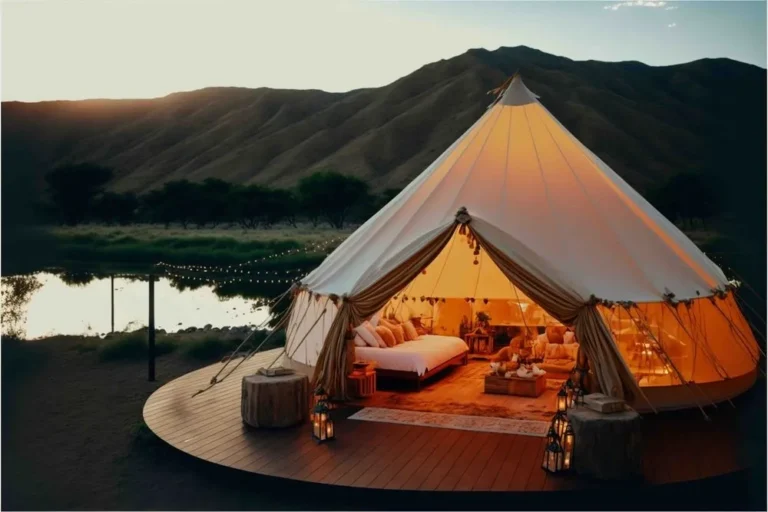
To identify the leaders in this sector, one must move beyond the visual allure of a canvas lodge on a pier. The peak of this market is defined by “Limnological Integrity.” The premier properties are those that have solved the “Access-to-Impact” equation. They provide a high-fidelity hospitality experience while ensuring that the infrastructure does not contribute to nutrient runoff or shoreline erosion. This report deconstructs the mechanics of elite freshwater stays. It provides a rigorous framework for evaluating the assets that define the contemporary standard for American lakefront luxury.
Luxury lakefront glamping USA

The technical definition of luxury lakefront glamping USA in 2026 has decoupled from “proximity” and moved toward “Atmospheric Control.” A multi-perspective analysis reveals that a property’s authority is built on its ability to provide a high-fidelity hospitality experience within the “Riparian Zone,” the interface between land and water. A genuine luxury stay in this category must solve the “Humidity Paradox.” It must ensure that interior linens, digital electronics, and guest comfort remain pristine despite the constant evaporation and moisture typical of freshwater basins.
A frequent misunderstanding is that these resorts are merely “lake houses” made of canvas. This oversimplification ignores the “Hospitality-to-Hydrology Ratio” that defines the premium tier. In a standard hotel, the guest interacts with a static building on dry land. In a top-tier lakefront glamping resort, the guest interacts with a shifting ecosystem. This requires the operator to manage water-level variations, seasonal algae cycles, and shoreline stability without the guest perceiving the heavy hand of management. The risk of oversimplification is high: a traveler may book a “lake retreat” only to find themselves in a high-density “sand-lot” where acoustic privacy is non-existent because sound carries perfectly across still water.
True mastery in this sector is identified by “Acoustical Isolation.” The premier properties found in the Adirondacks, the Northwoods of Wisconsin, and the glacial lakes of the Pacific Northwest differentiate themselves through “Soundscape Management.” They utilize natural topography and dense shoreline vegetation to create an auditory buffer from motorboat traffic and neighboring units. Excellence is achieved when the “lakefront” is a tool for profound silence, while the “infrastructure” remains entirely invisible.
Historical Context: From Great Camps to Managed Shorelines
The lineage of the American lake stay traces back to the “Great Camps” of the Gilded Age. These were massive timber estates where the elite sought a “primitive” connection to the Adirondacks. However, those structures were permanent and heavy. The modern iteration was born from a post-recession desire for “Light-Touch Luxury.” Between 2010 and 2020, the sector was dominated by “Lifestyle Operators” who focused on the aesthetic of the “Boathouse,” a period of “Nautical Romanticism.”
The current era, which matured in early 2026, is defined by the “Institutionalization of the Inlet.” Large-scale capital and seasoned hospitality groups have entered the space. They bring standardized service levels and professionalized housekeeping. More importantly, they bring “Systemic Environmental Governance.” This shift has transitioned the market from “camping by the water” to “floating hotels with canvas roofs.” We are now seeing the emergence of “Basin-Specific Architecture.” Resorts are now designed around the specific thermal and wind patterns of the Great Lakes, the Finger Lakes, or the high-alpine tarns of the West.
Conceptual Frameworks: The Three Pillars of Riparian Excellence
To evaluate the integrity of a high-end freshwater property, utilize these three mental models:
-
The “Moisture-Barrier” Model: This measures the resort’s ability to maintain a 45% internal humidity level while the exterior environment is at 90% saturation. Excellence is achieved when a resort uses integrated, silent dehumidification and vapor-barrier textiles in the tent liners.
-
The “Tidal-Equivalent” Framework: While lakes are not tidal, they experience “Seiche” events (wind-driven water level changes). This framework assesses a structure’s “Vertical Adaptability,” its ability to remain safe and dry despite sudden three-foot fluctuations in the water line.
-
The “Nutrient-Neutral” Logic: This assesses how a resort manages wastewater. A resort that utilizes decentralized, closed-loop septic systems that prevent nitrogen and phosphorus from entering the lake is superior. True luxury is protecting the water clarity that defines the guest’s view.
Taxonomic Variations: Structures and Regional Trade-offs
The American basin type dictates the architecture of the stay. A structure designed for the humid, mosquito-heavy lakes of the Southeast will fail in the high-wind, cold-water environments of the North.
| Category | Typical Region | Structural Strength | Tactical Trade-off |
| Floating Safari Tents | Gulf Coast / Florida | Total water immersion; Views | Vulnerable to storm surges and wakes |
| Glass-Front Cabins | Adirondacks / Maine | Wind resistance; Winter use | High heat gain; Requires heavy AC |
| Over-Water Yurts | Pacific Northwest | Aerodynamic stability; Privacy | Poor natural ventilation in high humidity |
| Canvas Boathouses | Great Lakes / Midwest | Iconic heritage; Social space | Constant moisture on wood finishes |
| Stilt-Pods | Ozarks / Appalachia | Erosion resilience; Safety | Physically demanding access (stairs) |
Realistic Decision Logic
Travelers must decide between “Direct Surface Access” and “Topographical Elevation.” A structure floating directly on the water offers the most authentic lake experience, but requires the guest to tolerate more movement and humidity. For those prioritizing “Sleep Stability,” a structure elevated on the shoreline with a private path to a dock is the superior play.
Operational Realities: Stress Tests and Real-World Scenarios
The “Wake-Action” Structural Stress
-
Context: A luxury floating tent located on a lake with active motorboat traffic.
-
The Event: A high-speed vessel passes within 100 feet, creating a three-foot wake.
-
Failure Mode: The structure’s moorings “snap” or the interior furniture is displaced, causing guest discomfort or minor injury.
-
The Elite Response: The site utilizes “Advanced Damping” docks and articulated mooring arms. These allow the structure to absorb kinetic energy without transferring it to the interior living space.
The “Algal Bloom” Olfactory Crisis
-
Context: A high-end resort during an unusually warm August.
-
The Event: The lake experiences a cyanobacteria bloom near the shoreline.
-
Failure Mode: The smell of decomposing organic matter infiltrates the guest tents, ruining the “Luxury” asset.
-
The Elite Response: Properties with “Technical Resilience” utilize shoreline aeration systems and “Bio-Filtering” floating wetlands. These maintain water movement and oxygen levels, preventing localized stagnation and odors.
Economic Dynamics: Cost Structures and Resource Planning
The financial profile of lakefront luxury reflects the massive overhead of “Shoreline Maintenance.”
| Resource Category | Direct Cost (Nightly) | “Hidden” Operational Expense | Justification |
| Core Lodging | $700 – $2,800 | “Moisture Tax” (Finish repair) | High capex for marine-grade hardware. |
| Culinary Logistics | $150 – $450 | “Last-Mile” Dock Delivery | Moving fresh goods via boat or boardwalk. |
| Resource Fee | $75 – $200 | Water Quality Monitoring | Funding the lake association and filtration. |
| Activity/Guide | $200 – $700 | Specialized Watercraft Labor | Hiring master canoeists and captains. |
The “Invisibly Displaced” Cost: Travelers should account for “Seasonal Opportunity Cost.” A site that is $300 cheaper in the spring may be plagued by “Black Fly” or “Mosquito” cycles. Peak value is found in late summer or early fall, when the “Insect Load” is low and water temperatures are stable.
Systems and Support: The Infrastructure of the Inlet
-
Marine-Grade Dehumidification: Essential for preventing the “damp sheet” feeling. Elite units use hidden, industrial-grade systems.
-
UV Water Purification: To ensure potable water in off-grid zones, resorts use high-intensity UV filters to treat lake or well water on-site.
-
Low-Profile Aeration: Small, silent bubblers placed around docks to prevent sediment buildup and maintain water clarity.
-
Mosquito-Magnet Mesh: Tents utilize high-density, “no-see-um” mesh that is coated with organic, scentless repellents.
-
Acoustical Buffering Plants: Using cattails, reeds, and willow thickets to absorb sound waves traveling across the water surface.
-
Solar-Powered Docks: Utilizing the unobstructed sun of the lake surface to power the resort’s lighting and climate systems.
The Risk Landscape: A Taxonomy of Freshwater Failure Modes
-
The “Nutrient-Loading” Failure: Poorly managed guest waste leading to localized algae growth, which ruins the “Pristine Water” asset.
-
The “Wake-Erosion” Lag: Failure to protect the shoreline beneath the structures, leading to foundation instability over 3–5 years.
-
The “Stagnation-Odor” Trap: Designing a camp in a sheltered “dead-end” cove where water circulation is insufficient.
-
The “Bio-Fouling” of Hulls: For floating units, the rapid growth of algae on the underside of the structure can increase weight and affect stability.
Governance, Maintenance, and Long-Term Adaptation
A premier lakefront site is defined by its “Riparian Governance.”
-
The “Post-Storm Silt Audit”: Full inspections of the shoreline and mooring points after any wind event exceeding 40 mph.
-
Review Cycles: Elite sites overhaul their “Soft Goods” and exterior timber finishes every 12–18 months to prevent “Grey-Rot” and mildew odors.
-
Adjustment Triggers: If a property experiences more than a 10% decline in water clarity (Secchi disk test), it triggers a mandatory review of the site’s wastewater systems.
Measurement and Evaluation: Quantitative vs. Qualitative Success
-
Leading Indicator: “Water Clarity (Secchi Depth).” A successful resort maintains or improves the clarity of the water directly adjacent to its units.
-
Lagging Indicator: “Interior Humidity Consistency.” Tracking the percentage of time the unit stays below 50% humidity.
-
Qualitative Signal: “Auditory Purity.” Measuring the decibel level of anthropogenic noise (boats, neighbors) during peak “Quiet Hours.”
Common Misconceptions and Market Oversimplifications
-
“Lake water is cleaner than the ocean”: Not necessarily. Lakes are closed systems and can trap pollutants and bacteria more easily than the open sea.
-
“Floating means moving”: The best floating glamping units are so well-moored that guests feel almost no motion except during heavy storms.
-
“All lakes have mosquitoes.”Most do, but elite resorts manage the “Landscape Hydrology” to ensure there is no standing water for breeding near guest units.
-
“Glamping is just camping for lazy people.”: It is a high-tech engineering solution for people who want the “Blue Space” benefit without the “Biological Friction.”
-
“You can swim anywhere”: Elite resorts designate “Swimming Zones” where the bottom is cleared of silt, and the water is tested daily for bacteria.
-
“It’s only for summer”: Some of the best lakefront glamping occurs in winter, with ice-fishing and “Cold-Plunge” sauna programs.
Ethical and Practical Considerations
In 2026, the “Ethics of the Basin” is a central theme. As luxury lakefront glamping USA continues to expand, properties must prioritize “Trophic Integrity.” This involves ensuring that the desire for the perfect dock does not destroy the “Littoral Zone,” the shallow water where fish spawn. From a practical standpoint, travelers must consider their “Chemical Footprint” using only reef-safe/lake-safe sunscreens and soaps to protect the delicate freshwater chemistry.
Conclusion
The evolution of the American lakefront represents a maturing of the domestic outdoor spirit. We have moved beyond the “extraction” of the fishing camp toward the “restoration” of the luxury sanctuary. The resorts that define the zenith of this market are those that act as silent stewards, providing the dryness, the safety, and the silence required for the human mind to settle. By focusing on “Limnological Integrity” and “Acoustical Isolation,” the best lakefront glamping resorts in the United States offer a portal to a version of the world that is both profoundly still and eternally refreshing.